The Muse That Sheds Its Skin
Every KOKET piece begins with a feeling before it ever becomes a form — and for Janet Morais, one feeling keeps returning in the shape of a snake. Of every creature she could have chosen as a muse, she chose the one that survives by shedding what it has outgrown. The serpent is one of the oldest symbols of feminine power in existence: renewal, rebirth, transformation, the body as something cyclical rather than fixed. Long before there was a Serpentine Collection to name, there was simply Janet’s fascination with a creature that mirrors everything she has built her house on — the belief that a woman, like a snake, is always capable of becoming something new.
That instinct is the true story behind the Serpentine Collection, KOKET’s ongoing exploration of snake-inspired furniture and the latest chapter in The Story Behind the Design series. It is not a single launch, but a lineage — a motif that first coiled into KOKET’s upholstery, then curled around a snake mirror frame, climbed a wall as a snake sconce, and, most recently, stretched flat underfoot as a snake-motif rug. Each piece born years apart, for different rooms. And yet each one carries the same unmistakable signature: renewal, rendered as luxury.
The First Coil: Mistress Confidante (2014)
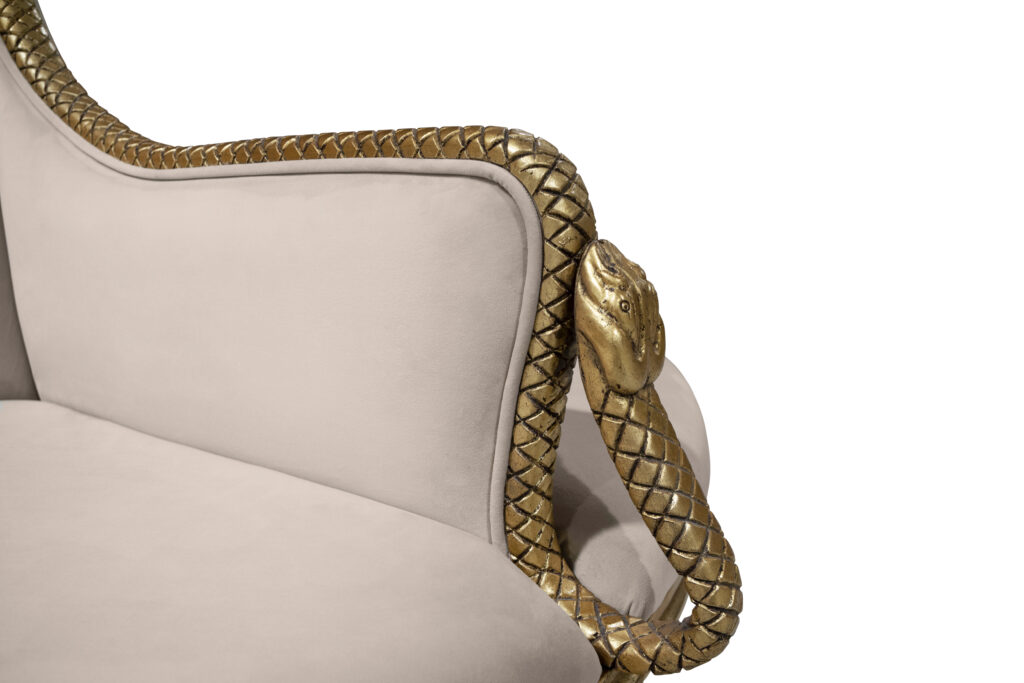
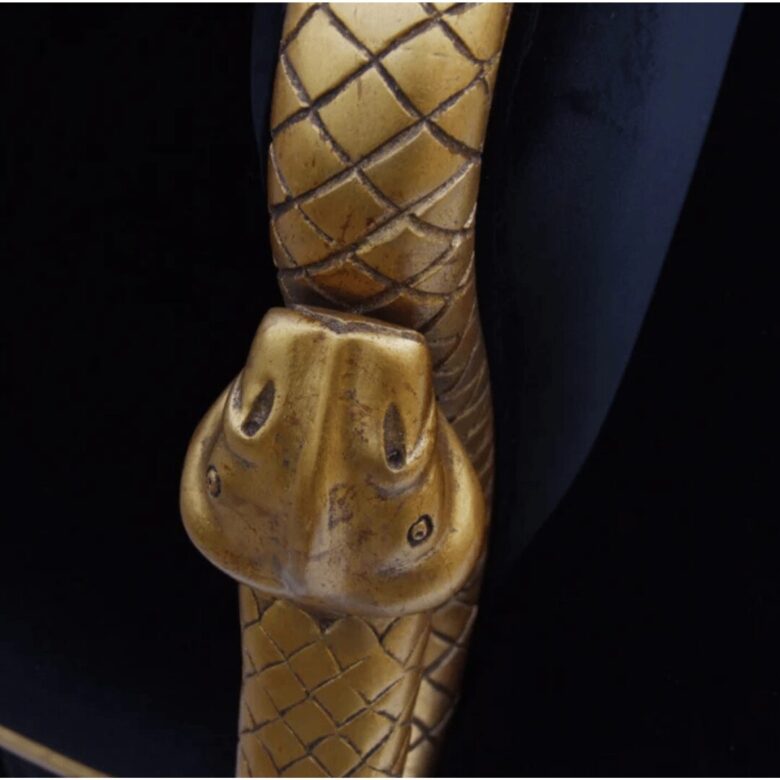
Before there was a Serpentine mirror or a Serpentine sconce to speak of, there was the Mistress Confidante — the round, richly upholstered sofa that gave the serpent its very first home in KOKET’s world, back in 2014. Two hand-carved serpents, finished in gold leaf, form the sofa’s curved arms, their heads rising at the front on either side of the seat — not hidden as an accent, but staged as the entire point. It is the piece’s spine and its story at once, holding two halves together while giving the whole thing its shape, and the earliest example of KOKET’s now-signature take on snake decor.
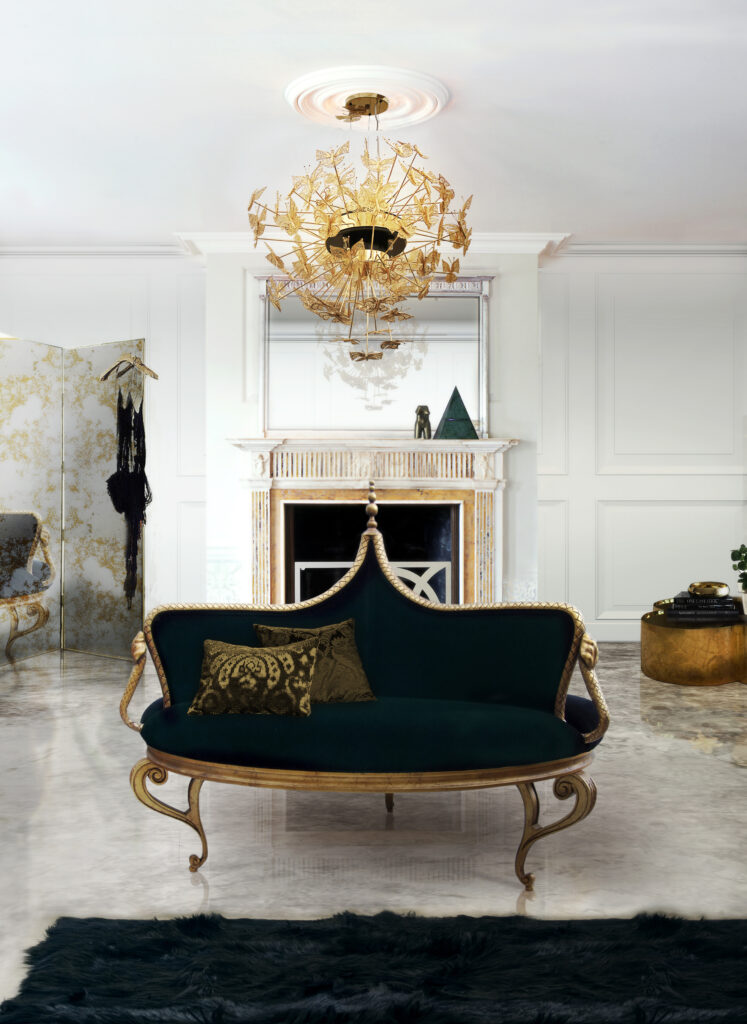
“I love the aura it exudes — almost luring you in with the menacing hand-carved serpents,” Janet has said of the piece. “Snakes are very symbolic creatures, and I love to depict them in KOKET pieces.” It remains, by her own account, one of her favorite designs. That devotion matters. It tells you the snake was never meant as decorative shorthand for “nature.” It was chosen the way a couturier chooses a silhouette — the same instinct fashion has drawn on for decades, from the coiled bodices of designers like Zuhair Murad. On a woman’s body, the serpent has never been a threat. It is armor that moves. Here, that same idea is symbolized in duality — softness and strength held in one curved form — and in associations of health and vigor that predate furniture entirely. A sofa, of all things: a piece built for rest, for intimacy, for conversation, split open by a symbol of transformation. Less an accent than a quiet declaration — that a woman can be soft and be power, at once, without ever choosing between them.
Mistress Confidante was never a footnote to the Serpentine story. It was the opening line — the moment the serpent first found its home in the KOKET house, four years before it had a name of its own.
The Serpentine Snake Decor Collection Takes Shape (2018–2019)
The Serpentine Collection, named and complete, arrived in 2018 — and it did not arrive quietly. It debuted on the world stage, at Salone del Mobile Milano and Maison et Objet, the two rooms where the design industry decides what matters next. It arrived as a Serpentine mirror and sconce.
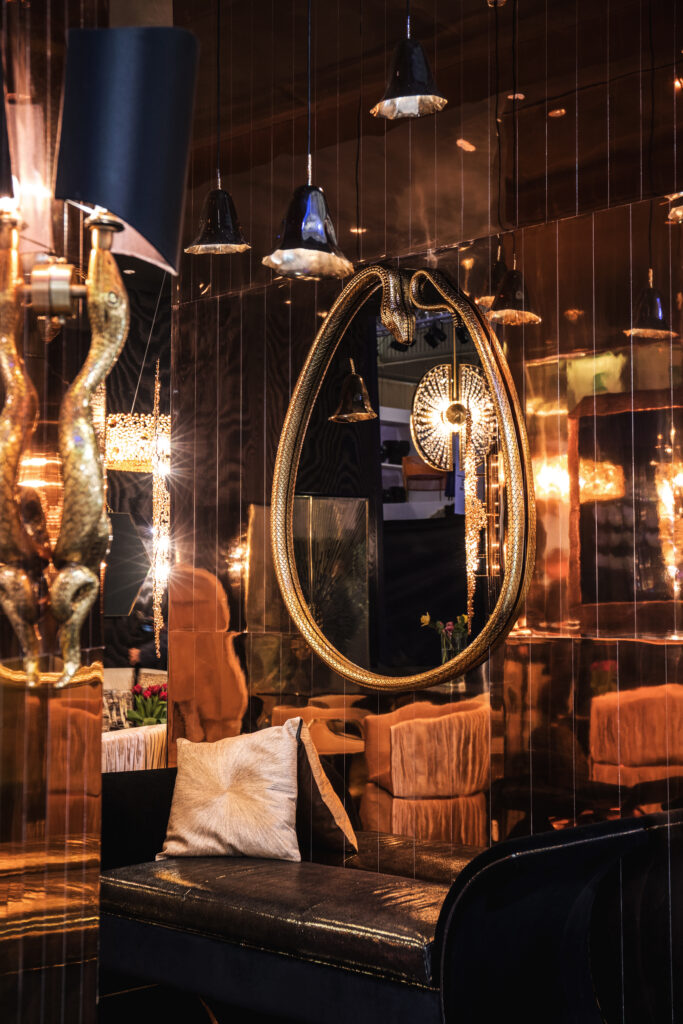
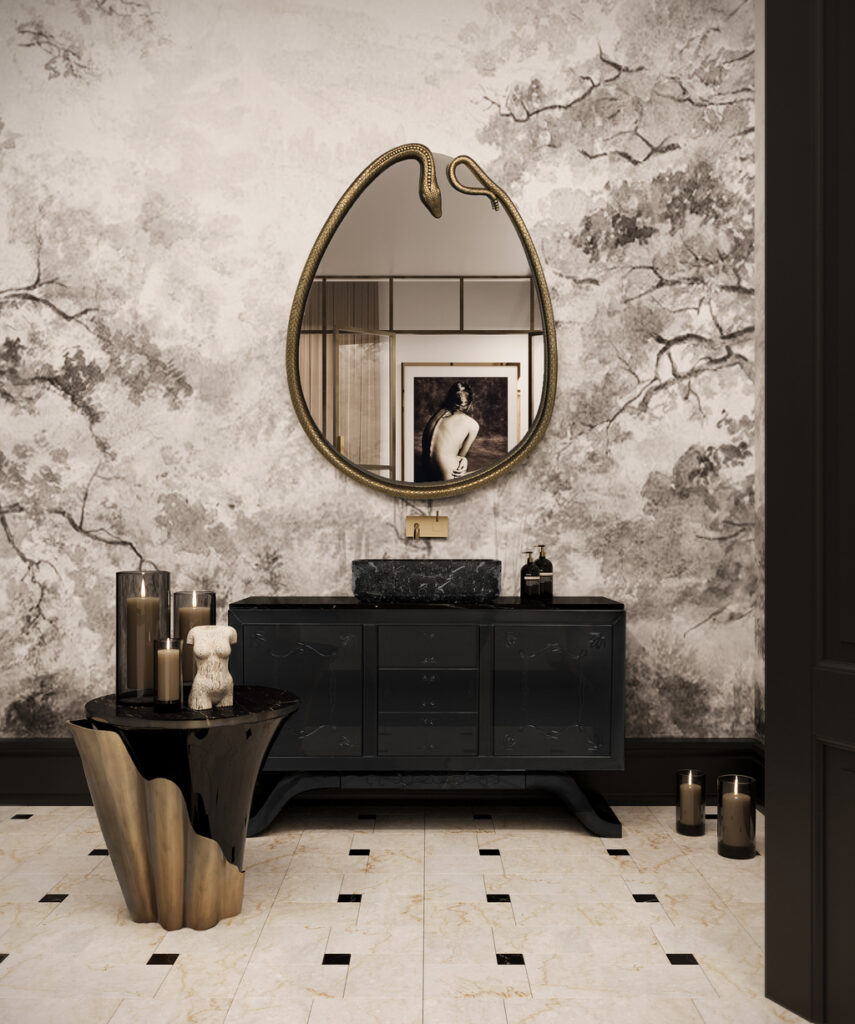
Of every object to carry a symbol of renewal into, KOKET chose the one piece of furniture built for a woman to look at herself. The Serpentine Pear-Shaped Mirror debuted that year as the brand’s first true foray into snake decor as a category of its own: a hand-carved wood frame shaped like a single serpent, coiled so its head crowns the top of the mirror and its body curves downward into a soft, pear-like silhouette. As far as snake decor mirrors go, it set the template for everything that followed. Hand-carved from wood and finished in broken gold leaf, paired with a bronze mirror plate, standing 135 cm tall, it was never designed to simply reflect a room. It was designed to watch a woman transform in front of it — the same way a serpent watches its old self fall away.
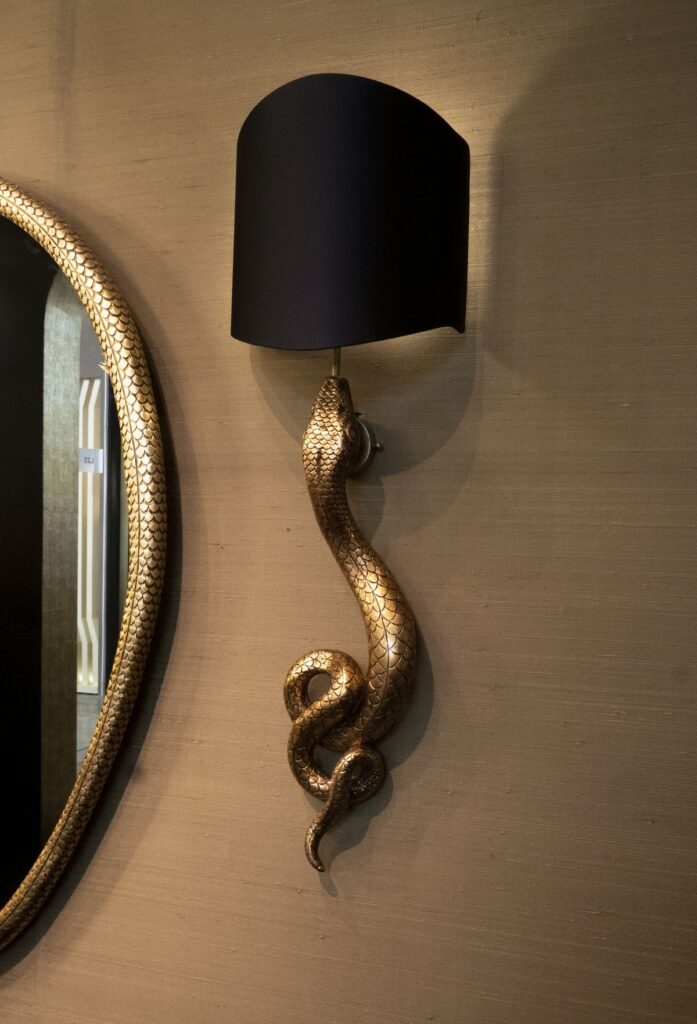
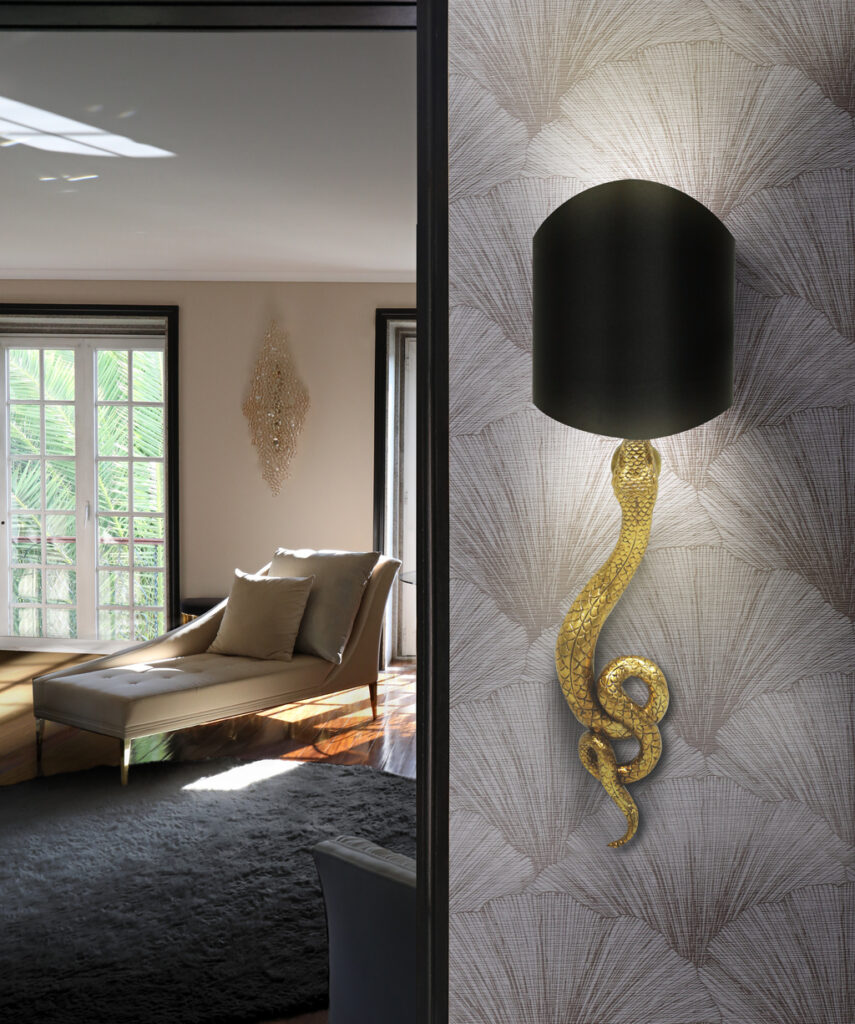
Launched the very same year, the Serpentine Sconce took the motif off the wall’s flat plane and let it move. This piece of snake lighting is hand-carved and finished in broken gold leaf, paired with a satin-lux black shade, its coiled tail climbing the wall as though it may unwind at any moment. As a snake sconce, it is the smallest of the pieces, and in some ways the most literal about what renewal looks like in practice: light, cast exactly where a woman chooses, by a creature caught perpetually mid-shed.
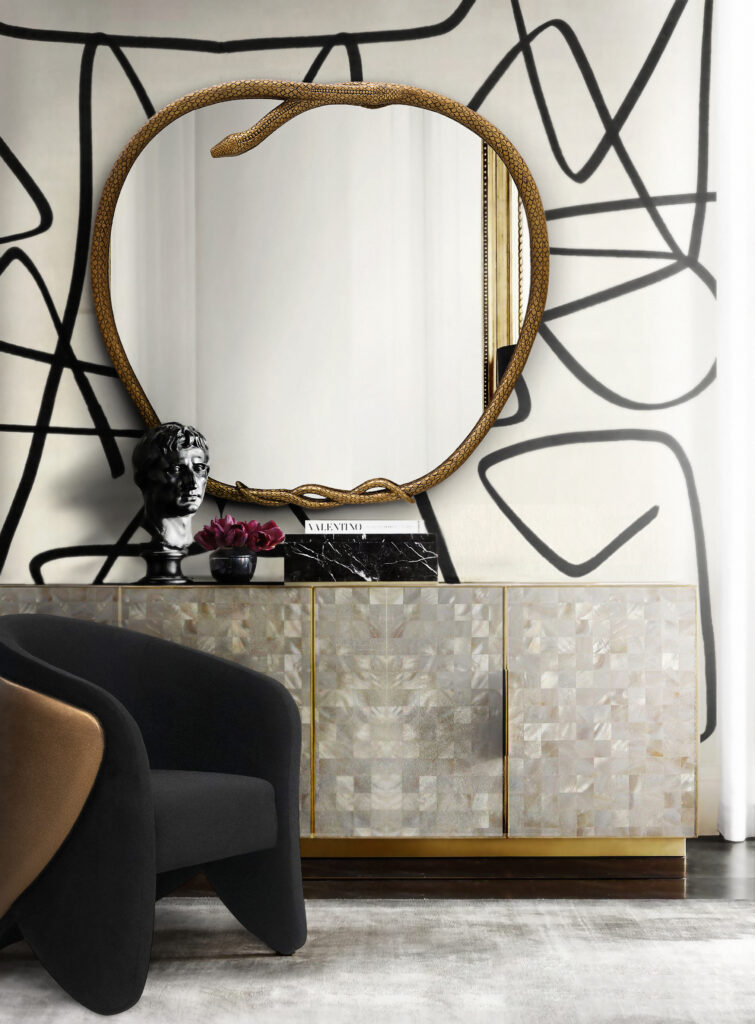
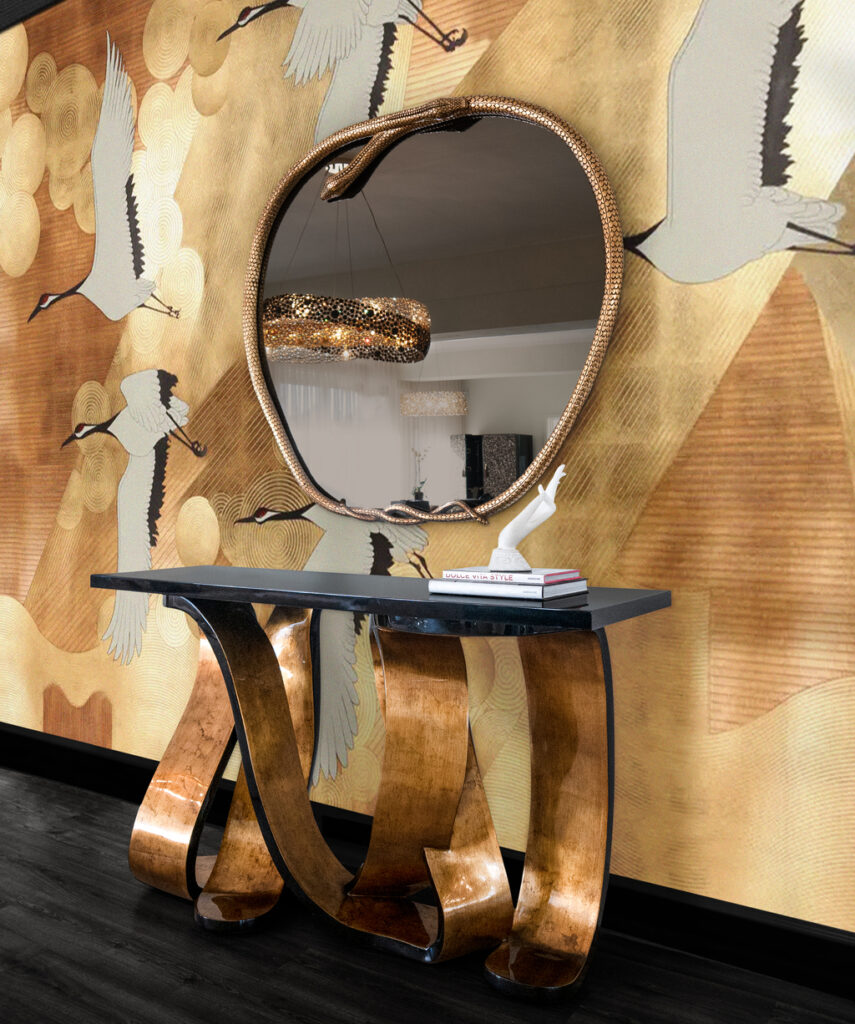
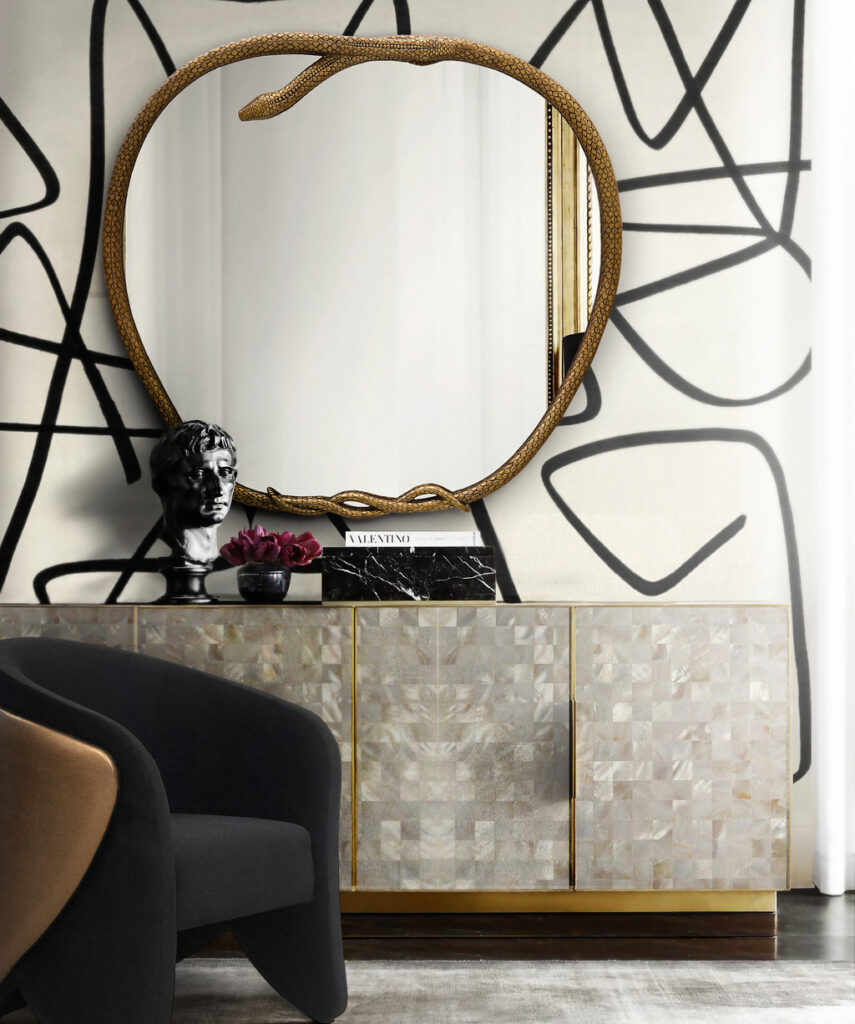
A year later, in 2019 — introduced again at Maison et Objet, the fair that had already watched the collection take its first bow — the Serpentine Apple-Shaped Mirror completed the trio — a second snake mirror, this one built from intertwined, hand-carved serpents forming the frame, finished in the same broken gold leaf, extending the pear mirror’s single coiled silhouette into something rounder, fuller, more entangled. Where the pear mirror reads as one serpent in profile, the apple mirror leans fully into the intertwining, multiple serpentine forms wrapped around each other. And for an object shaped like an apple, framed by serpents, the reference does not go unnoticed. A story that has spent centuries blaming a woman for wanting to know more, recast entirely — as a mirror. Knowledge, curiosity, transformation: reclaimed as decor.
Across all three pieces of snake decor, the symbolism holds, and it keeps circling back to the same feminine register. The serpent has meant different things across different cultures for thousands of years — rebirth, transformation, immortality, healing, the endless renewal of life — and across nearly all of them, it is bound to goddess figures, fertility, and a cyclical nature long associated with womanhood itself: a body that changes shape and comes back stronger. The Serpentine Collection does not choose one meaning and insist on it. It lets the ambiguity do the work. Is the serpent seducing you, protecting you, or simply becoming something new in front of you? Every reading lands in the same place. This was never really about the animal. It was about giving an ancient symbol of feminine renewal a home in the rooms where women actually live.
Craft in Every Coil
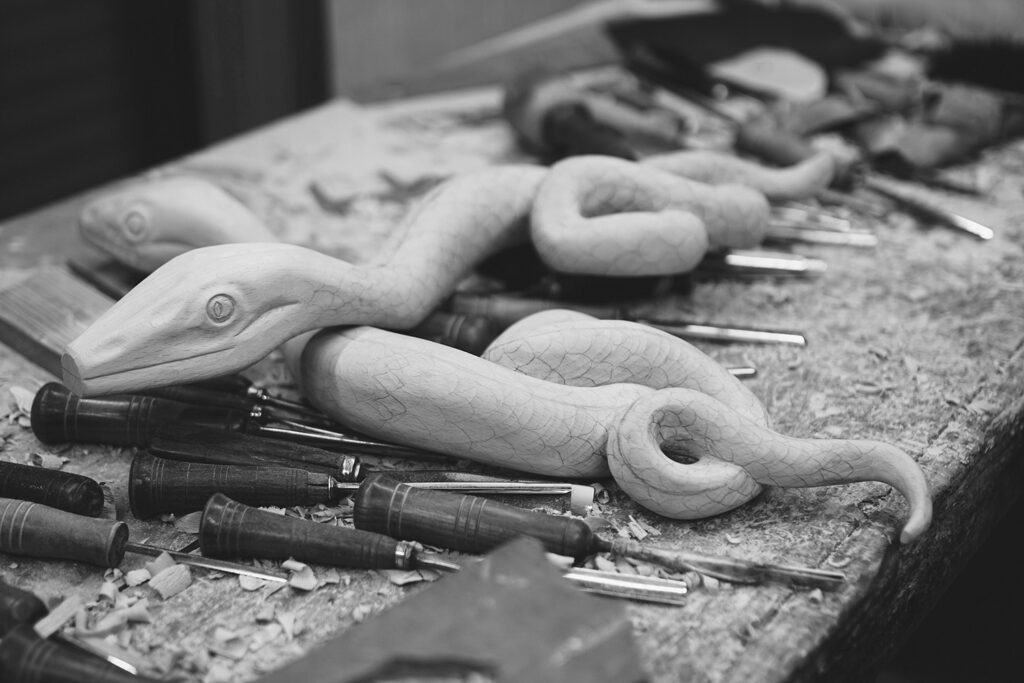
None of it works without the hands behind it. Every piece of Serpentine snake decor is hand-carved from wood in KOKET’s Portuguese ateliers, then finished in broken gold leaf by master artisans — which means, true to the house, no two pieces are ever quite identical. Slight variations in the carving, in the way the aged brass catches light, are not treated as inconsistency. They are proof of the human hand. The high-gloss broken gold leaf finish alone is a labor-intensive, multi-step process, applied so the metal catches light unevenly — the way real scales would. Every piece, in other words, is made to look mid-transformation: caught in the act of catching light differently than it did a moment before.
It is a level of craft that turns a decorative object into something closer to sculpture that happens to hold a mirror, or a bulb — precisely how KOKET defines exotic furniture as a category: unique materials, an eclectic atmosphere, and above all, a rarity that makes a piece a conversation starter rather than a backdrop.
Beyond the Bedroom Mirror: Serpentine in the Wild
Serpentine rarely stays confined to the room it was designed for. Over the years the pieces have settled everywhere from entryways built around botanical, nature-inspired design to interiors that lean fully into wild, animal-inspired design — the snake sconce reads as comfortably in a jungle-glam hallway as it does alone against a bare wall, and the Pear-Shaped snake mirror has made an unexpected case for daring bathroom design, reframing a room no one thinks to be bold in. Every setting pulls something different out of the gold: warmer against dark wood, sharper against lacquer, almost feral against stone.

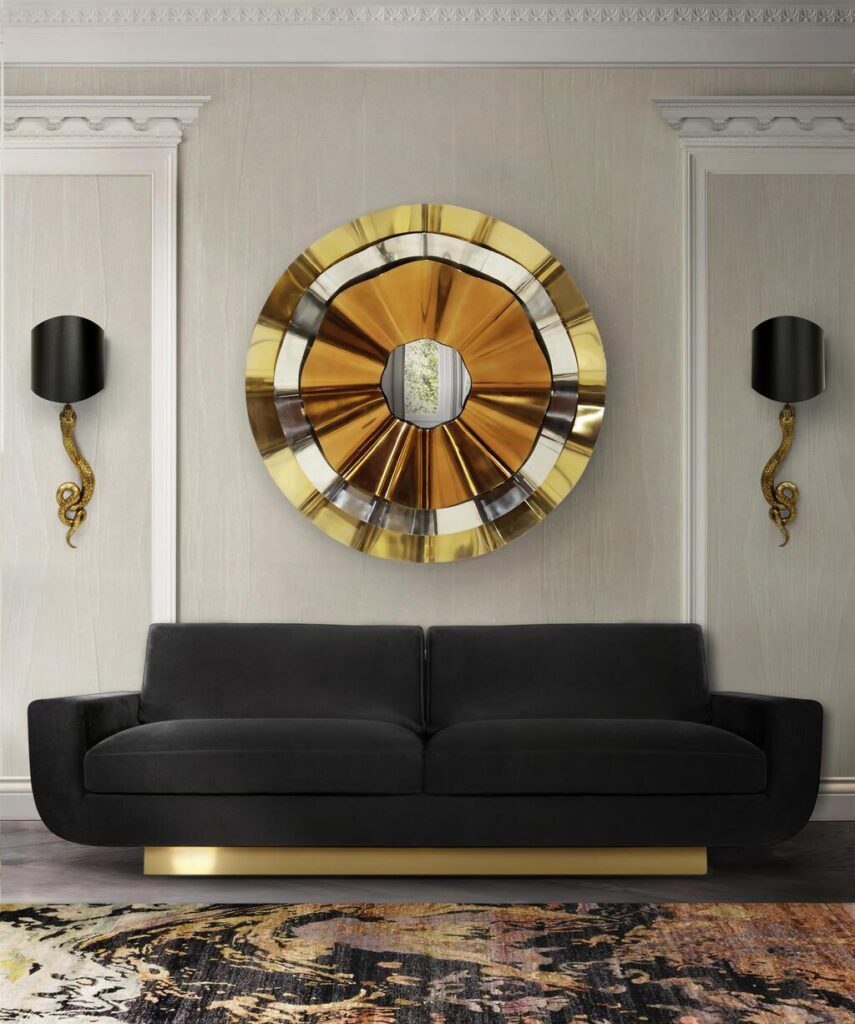
A motif born from one designer’s personal fascination became, over time, part of the house’s larger visual vocabulary — the snake lighting and snake mirrors reached for whenever a room needs a little more nerve, or the woman in it needs a small daily reminder that renewal is always hers for the taking.
The Newest Coil: The Serpenti Rug (2026)
The most recent chapter in the story does not hang on a wall. It lies underfoot. Launched in January 2026 as part of KOKET’s Soft Pleasures rug collection under artistic director Sofia Silva, the Serpenti Rug translates the collection’s signature coil into hand-tufted wool and bamboo silk, offered in two colorways: Serpenti Beige, in soft neutral cream and gold, and Serpenti Wheat, a warmer, deeper variation on the same coiled form. In both, sculptural bamboo-silk relief traces the serpent’s shape across the surface, drawing on flowing serpentine movement to create a sophisticated, calming presence underfoot — a quieter, softer register than the snake sconce’s coiled tension or the snake mirrors’ watchful gaze, but unmistakably of the same house.
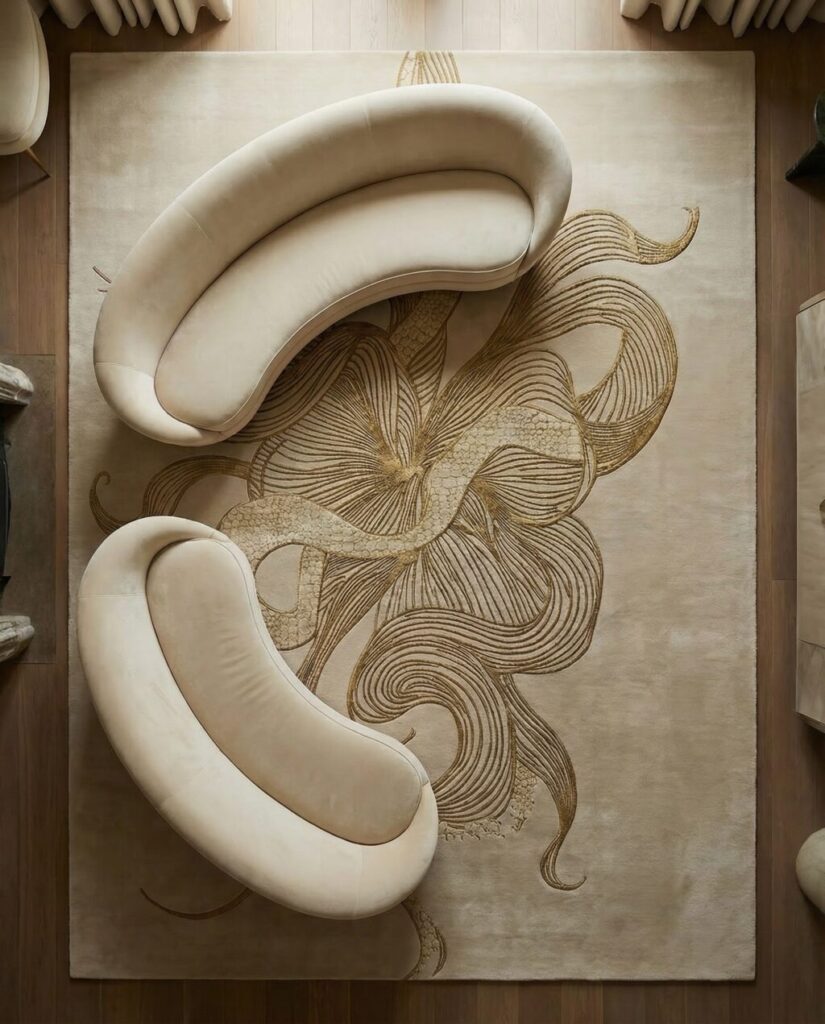
If the mirrors ask a woman to watch her own transformation, and the sconce lights her way through it, the rug simply lets her stand on solid, renewed ground. Proof that power does not always have to announce itself to be felt.
The motif has now passed to a different creative hand — Sofia Silva’s rug studio. It has become part of KOKET’s design DNA, carried forward by another woman in the house, reached for whenever a piece of snake furniture needs to feel a little dangerous, a little transformative, a little alive. Twelve years after Mistress Confidante first gave the serpent a home, the motif shows no sign of slowing down.
A Motif That Keeps Shedding Its Skin
From a single carved serpent splitting a sofa in two, to snake decor that watches a woman become someone new, to a rug soft enough to walk on — the story of the Serpentine Collection is the story of an idea that refused to stay in one object. Snakes, after all, are the animal kingdom’s original symbol of renewal. They do not disappear. They molt, and come back changed. A fitting emblem for a house built by a woman, largely for women, on the belief that reinvention is not a phase to age out of — it is a power to keep using.
Twelve years in, and counting: it would be a surprise if the Serpenti Rug turned out to be the serpent’s final form. If the house’s history is any indication, the appetite for snake furniture at KOKET isn’t finished yet. It is simply waiting for its next skin.
Explore KOKET’s snake decor, including the Mistress Confidante, Serpentine Collection Sconce and Mirrors, and the Serpenti Rug.