

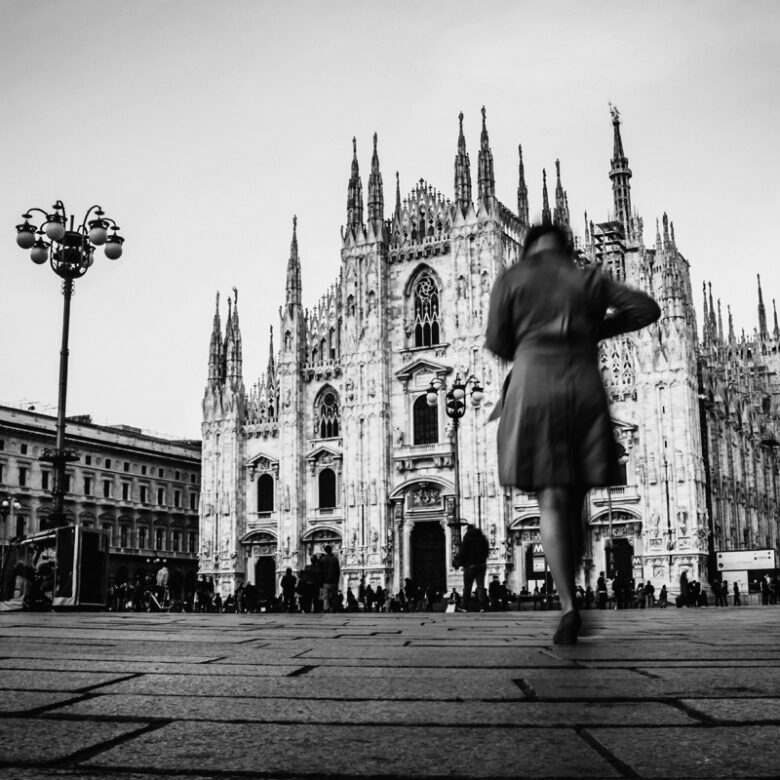
We arrived in Milan this April with a familiar sense of anticipation. Milan Design Week has long been a cornerstone of the global design calendar—anchored by Salone del Mobile.Milano and amplified by the citywide energy of Fuorisalone. But this year, something felt different. The city was electric—overflowing, even—with streets packed, installations buzzing, and events layered across every neighborhood. And yet, somewhere between the spectacle and the scale, a question lingered: has Milan Design Week become too much?
The Rise of the Spectacle
There is no denying the power of what Milan has become. Global brands showed up in force, creating immersive, high-production exhibitions that blurred the lines between fashion, art, and design. Names like Gucci, Prada, Louis Vuitton, Dior, and Hermès drew massive crowds, with visitors lining up for hours and treating installations as cultural moments rather than purely design-driven experiences.
And in many ways, this evolution feels almost inevitable. Milan has long been one of the world’s fashion capitals—a city where design, craftsmanship, and style have always coexisted. The presence of fashion during design week is not new; it is embedded in the city’s identity.
This crossover is something we at KOKET embrace, where materials, artistry, and storytelling move fluidly between body and space. But this year, the balance shifted. Fashion didn’t just participate—it dominated, pulling attention toward spectacle and scale in a way that redefined the rhythm of the week.
When Attention Becomes Currency
What we witnessed across the city was, in many ways, a redistribution of attention. Crowds gravitated toward headline installations, often bypassing smaller studios, independent designers, and master artisans who have historically defined the soul of Milan Design Week. Conversations throughout the week echoed a shared sentiment: it began to feel less like a design week and more like a carnival.
That energy brought undeniable visibility, but it also introduced tension. Because while large-scale activations elevate Milan’s global relevance, they risk diluting the intimacy and intention that once defined the experience—where discovery, conversation, and craftsmanship were at the center.
And What About Salone?
The contrast becomes even clearer when looking at the numbers. Salone del Mobile.Milano itself saw an increase in attendance this year, recording approximately 316,000 visitors—by all traditional measures, a strong and successful showing. However, the city of Milan is estimated to have welcomed between 500,000 and 800,000 people during the same period.
This gap reveals a meaningful shift. A significant portion of those who traveled to Milan for “design week” 2026 never entered the fair at all—or did so only briefly. Salone, once the unquestioned anchor, is now part of a much larger, more diffuse experience. And when the center begins to shift, the role of the fair itself inevitably comes into question—not in terms of success, but in terms of influence.
The Other Side: Evolution or Dilution?
To frame this evolution as entirely negative would be too simple. Milan Design Week has never been more culturally relevant, nor more globally visible. The convergence of fashion, art, and design reflects a broader shift in how we experience creativity today—fluid, interdisciplinary, and increasingly driven by emotion and immersion.
In a world shaped by economic uncertainty and a collective sense of fatigue, this scale of spectacle may not be excess for the sake of it, but rather a response—a way of creating moments that feel larger, more engaging, and more alive.
Who Got It Right
Amid the noise, there were still moments of clarity. Some exhibitions managed to strike a balance, where storytelling elevated craftsmanship rather than overshadowing it. These were the spaces that invited pause rather than demanded attention, proving that impact does not require excess.
In a week defined by scale, restraint became its own kind of statement.
Where Do We Go From Here?
As we reflect on Milan Design Week 2026, the question is not whether what we witnessed was good or bad, but what it signals for the future. Fashion has a place in this conversation—it always has—but the challenge now lies in maintaining space for the designers, artisans, and makers who built this platform, even as it continues to evolve.
Because if everything becomes spectacle, we risk losing the substance that gives the week its meaning. And if we resist change entirely, we risk losing relevance.
A Moment of Reckoning
Milan remains the epicenter of design. That much is certain. But this year felt like a turning point—a moment of recalibration where the industry must decide what Milan Design Week stands for moving forward. At KOKET, we believe in the power of both worlds: the emotion of experience and the depth of craftsmanship. The magic happens when they meet, not when one overtakes the other.
And perhaps that is the real takeaway from Milan Design Week in 2026—not that it was too much, but that it may be time to redefine what enough looks like.


